Showing posts with label green design. Show all posts

Sunday, 6 June 2021

The Game Changer For Malaysia's Town Planning

The Malaysian state of Penang is fast becoming an IoT-Enabled Smart City modeled on the tenets of green living, strong ESG principles and sustainable economic momentum. Soon, it could be one of Southeast Asia’s hottest investment destinations.

Central to that transformation is Penang South Islands (PSI). The three-island development will help the state achieve its Penang2030 vision. By combining advanced technologies for next-generation industries with eco-friendly masterplans, PSI will raise the game for Penang as a leading investment destination for global corporations.

“The PSI Green Plan will play a vital role in making that happen,” says Chow Kon Yeow, Chief Minister of Penang. “The PSI targets a 50% reduction in CO2e emissions by 2030 compared to business as usual. Coupled with Penang’s advanced manufacturing capabilities, ESG principles will make PSI the ideal choice for global businesses to build their manufacturing hubs while meeting their sustainability targets. Especially in the electronics, medical devices and other high-end sectors where Penang already makes significant contributions.”


A Green Plan for the Penang South Islands


The PSI Green Plan promises big outcomes: 100% renewable energy for powering the Green Tech Park; a 40% reduction in urban planning emissions; a 40% reduction in non-renewable energy use from super low energy buildings with efficient cooling systems, smart features and renewable energy installations; a 70% reduction in freshwater demand from the dual-purpose sewage treatment plant, rainwater harvesting and water saving devices; and a 65% reduction in landfill waste with extensive recycling, food maceration and composting.

The plan addresses the UN Sustainable Development Goals (SDGs)1–a much-needed achievement given that Asia remains far from meeting any of the SDGs. In turn, PSI will become an advanced new ecosystem that serves as a model for the future of work, livability and sustainability around the world.
“The PSI Green Plan will accelerate the ‘greenification’ of Penang’s economy, governance and infrastructure,” the Chief Minister says. “It will enable Penang to reach its full potential as a high-income, low-carbon state that prioritizes the well-being of its people and the environment while providing a platform for innovative and sustainable-minded businesses to thrive.”


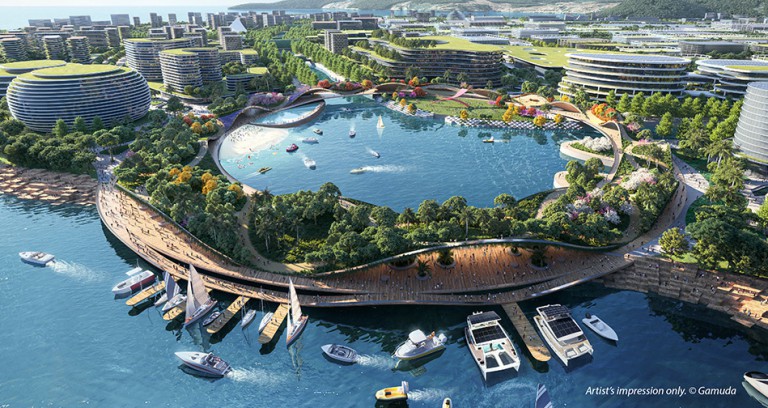
The environmentally conscious, people-first masterplan also puts pedestrians, bicycles and water transport ahead of cars. The goal is to achieve a 70:30 public-private modal share, compared with 5:95 currently. To make that happen, PSI will include 140 kilometers of bicycle and walking tracks as well as seven kilometers of navigational waterway. These transportation pathways will reduce transport-related emissions by up to 80%.

“There will be generous provision of public open spaces island-wide (900ac), including beaches, mangroves, water canal, wetlands, flood plains and bioswales enhancing the biodiversity design of the island by connecting people with greens and water,” the Chief Minister says. “It will also reduce the Urban Heat Island effect and reinforce the design resiliency towards flood, erosion and sea level rise.”


Expanding Penang’s Tech Legacy


As innovative companies gravitate to Penang, PSI will fuel growth in the state’s well-established tech manufacturing sector. Dubbed ‘the Silicon Valley of the East,’ Penang already produces 8% of global back-end semiconductor output. With end uses linked to 5G, autonomous vehicles and the IoT, chips made in Malaysia power some of today’s most innovative products, making Penang a vital link in electronics supply chains.

Where Penang was a hub for labor-intensive manufacturing decades ago, today it designs and produces high-value-added technologies, that spans everything from integrated circuits and software to embedded systems. Penang’s steady climb up in the value chain continues to attract some of the most innovative companies in the world. They are setting up Centers of Excellence, Design Centers and R&D Hubs to tap into the state’s unique advantages. In the years ahead, PSI will provide space for more companies to do the same as they move up the value chain.


In 2019, Penang drew a record MYR16.9 billion ($4.1 billion) in manufacturing investments—nearly 90% of which went to the Electrical & Electronics, machinery and equipment, and scientific and measuring equipment (including medical device) sectors. In 2020, despite the ongoing Covid-19 pandemic, U.S. front-end semiconductor equipment giant Lam Research announced a USD225 million investment to build the group’s largest manufacturing facility in Batu Kawan Industrial Park. The company will join dozens of tech heavyweights including Intel, which has one of the largest silicon design centers in Penang; Micron Technology, which built a center of excellence for solid state drives in Penang; and National Instruments, which has its largest R&D facility outside of the U.S. in Penang.


“Chip-making is a very complex process that requires manufacturing expertise,” the Chief Minister says. “Through decades of hard work, Penang has developed the talent and know-how to meet the needs of technology companies around the world. PSI will build on those strengths, taking Penang’s manufacturing capabilities to the next level while taking sustainability, the environment and lifestyle into account for businesses and their employees.”


Source: Bloomberg.com

Saturday, 5 June 2021

A Perfect Design For The Tropics

Sindhorn Village is a luxurious, mixed-use development in central Bangkok. The master plan of this new landmark also features a generous green space with a low-density ratio that will enhance its residents’ living standards. Sindhorn Village consists of the Sindhorn Residence condominium, Baan Sindhorn serviced apartments, Kimpton Maa-Lai hotel & restaurant, Sindhorn Kempinski hotel & residences, an art museum and the Velaa retail plaza.

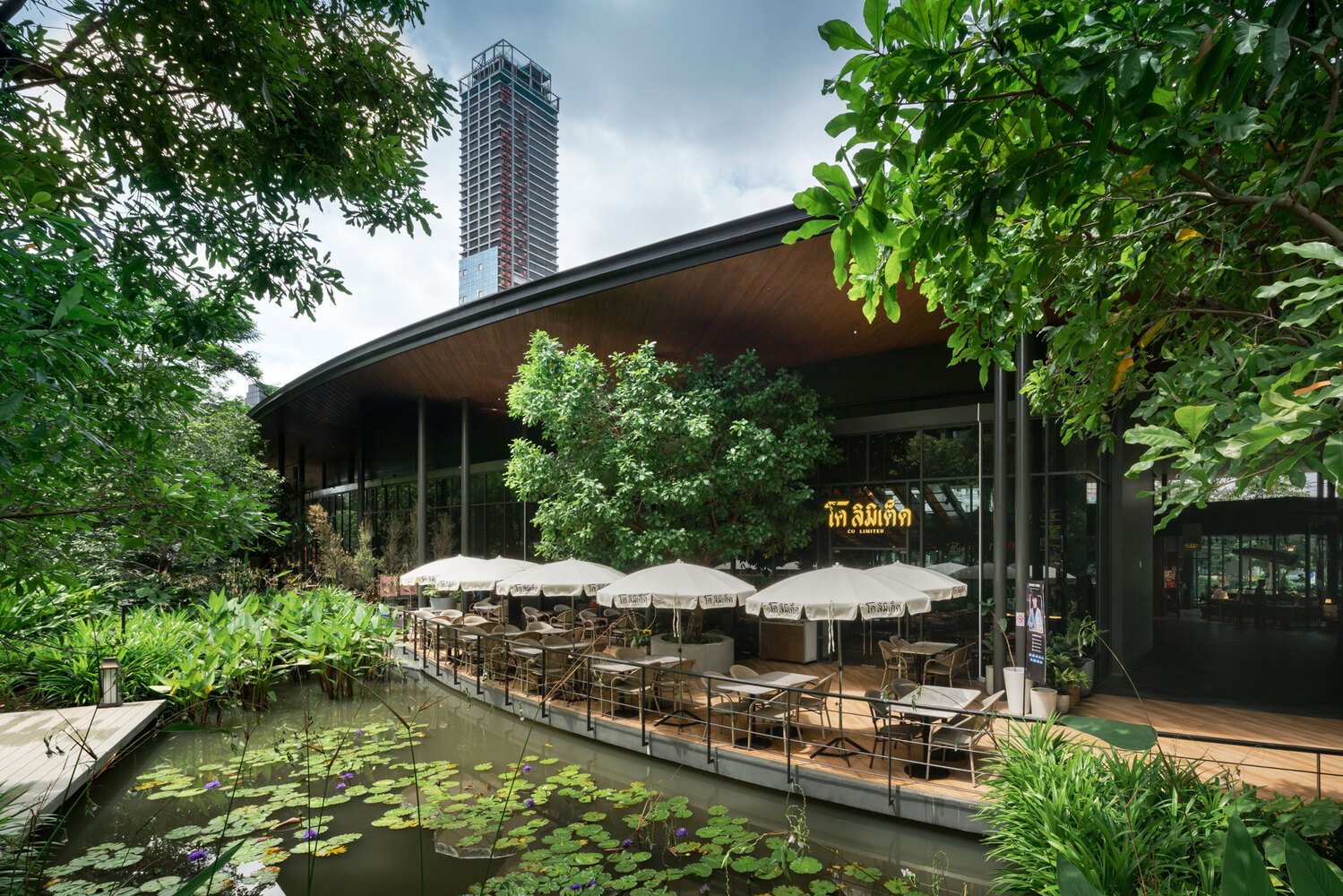
Velaa Sindhorn Village is the fruition of A49’s award winning design. The single-story semi-outdoor retail mall merges with the green space called Super Green. Cafes, restaurants, shops, services and a below-ground supermarket are weaves together along this green space creating a seamless connection to the surrounding urban fabric. Areas dedicated to community use, or “green courts” are interspersed throughout this complex.

The design of the retail buildings meanders 300 meters along Langsuan Road, around the established large trees, effectively creating a ribbon of shops and restaurants. This formation, along with the tall façade, makes each shop visible from the street, attracting customers. There is no need for air conditioning in this complex as open plan walkways allow for natural ventilation. The perforated canopy roof over the shopping areas and pedestrian walkways is supported by branches of treelike columns to mimic the experience of strolling in a park.

Rays of light filtering through the roof canopy of the five main courts shimmer and create shadows below like the pattern of leaves, allowing natural daylight into the interiors. Lighting design, both warm and welcoming, illuminates the night through the perforations like fireflies in an enchanted forest.

Sindhorn Village 是位于曼谷市中心的一项豪华综合发展项目。这个新地标的总体规划还包括一个低密度的宽敞绿地,这将提高居民的生活水平。


Velaa Sindhorn Village 是 A49 获奖设计的结晶。单层半户外零售商场与名为 Super Green 的绿地融为一体。咖啡馆、餐厅、商店、服务和地下超市沿着这个绿色空间编织在一起,与周围的城市肌理形成了无缝连接。


这座建筑物围绕着大树,有效地创造了一条商店和餐厅的带状结构。这种形式,连同高大的立面,使每家商店从街上都能看到,吸引了顾客。这座建筑物不需要空调,因为开放式走道允许自然通风。购物区和人行道上的穿孔天篷由树状柱子的分支支撑,以模仿在公园散步的体验。


光线透过五个主要庭院的屋顶天篷闪烁着微光,并在下方形成树叶图案的阴影,让自然光进入室内。灯光设计,既温暖又好客,透过穿孔照亮夜晚,就像梦幻森林中的萤火虫。


Saturday, 17 October 2020

Factory In The Forest


Text description provided by the architects. 
Architectural competition winning entry for an electronics manufacturing plant. This site is conceived as a forest that penetrates, surrounds & steps over the building creating maximum contact with nature – green, breeze, scent, sound, touch. A canopy supported by a ‘forest’ of columns creates unity to office & courtyard while giving protection from the tropical sun. Office levels give access to roof gardens and staff are encouraged out for breaks, meetings or just contemplation.


A green courtyard separates the office & factory with views and access from both. A bridge over the courtyard links the office & production & this circulation route becomes a space for meetings, breaks & lectures. The factory has views to landscape & the sky condition through full height & clerestory glazing with glazing protected from the sun by free-standing off-form concrete fins and roof louvers. Rainwater cascades from roof spouts - heightening awareness to tropical storms, to storage tanks for landscape irrigation.


The plant receives natural diffused light across the entire factory floor reducing dependency on artificial lighting that, combined with chilled water floor slab cooling & cutting-edge air-conditioning technology reduces energy consumption to half that of a conventional plant of similar size.


Structure & materials are expressed; off-form reinforced concrete and steel structure, glazing and landscape. With this small palette of materials, the building explains to us what it is, what it is made of & how it is put together. The approach was to create a stimulating & meaningful working environment for all employees – the forest to be the face of the building & company. Forests, critical for both macro & micro-climates are also vital for our psychological well-being.

Sustainability - From project onset, the client wanted an energy efficient and climatically responsive building. The cardinal sustainable design principles were energy efficiency, water efficiency, daylighting and biophilia – the fundamental human need for connection to Nature.

The building is designed to shield against the hot & glaring tropical sun, while allowing diffused natural daylight to filter into the building. The office & courtyard are shaded by a louver canopy designed to provide effective solar protection during the hottest part of the day.

The factory skylight design was optimized to achieve an evenly day-lit work environment. The simulations and daylight measurements in operation show that the factory floor achieves an evenly day-lit work environment without glare throughout the year. Dimmable daylight responsive LED lighting and individual task lighting ensures that the required light levels are always obtained.

An innovative radiant floor cooling system works with embedded PEX pipes in the concrete slabs throughout the factory & office. By cooling down the slabs to about 21°C, this structural element of the building doubles up as part of the cooling system. The higher chilled water temperature and the water-borne cooling transport makes the radiant floor slab cooling twice as energy efficient as conventional air-conditioning.

Source: Archdaily

Tuesday, 25 August 2020

China's Electric Tram

Quick charge! A self-driving super capacitor tram has rolled off the production line in China’s Hunan. This eco-friendly tram can run for 5km after charging for only 30s! With a capacity of 500 passengers and a maximum speed of 70km/h, it will operate at Kunming Changshui International Airport.


Tuesday, 14 November 2017

China Leads The World Into The Future


China is the world's largest solar power producer.

China is investing $364 billion into renewable power generation.

China reached its 2020 solar power target 3 years early.

China is using AI to improve healthcare and speed up diagnoses.

Chinese scientists invented rice that can grow in salt water which can feed over 200 million people.

Chinese discovered a way to turn sand into fertile soil which helped convert deserts into lands rich with crops.

At least 1 billion Chinese could be using 5G mobile networks by 2023.

Chinese are now using mobile payment instead of cash.

China teams up with Europe to build a base on the moon.

China will also send an unmanned probe to Mars by the end of 2020.

China built the world's largest telescope to study the universe.

China is constructing buildings as vertical forest in an attempt to fight air pollution in her major cities.

China has the world's largest bullet train network.